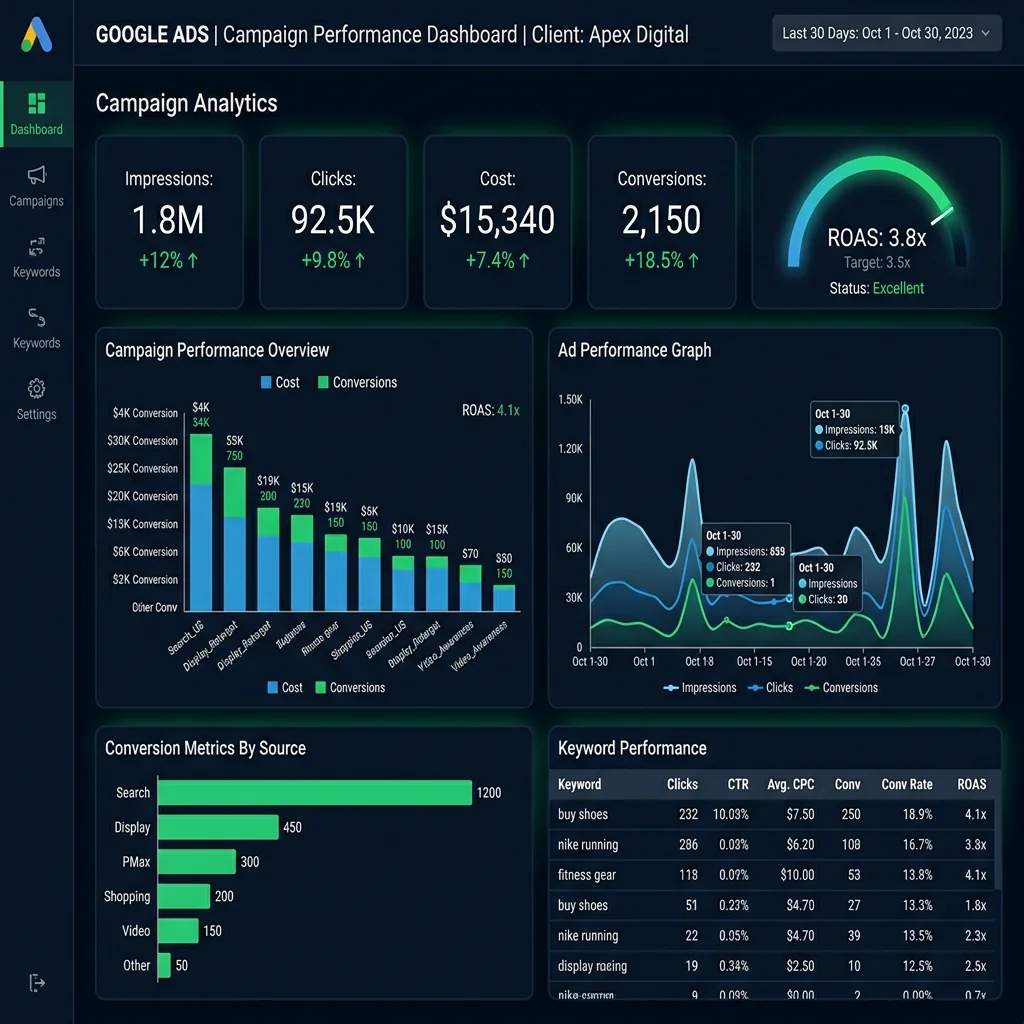
Key Takeaway: Quality Score is a diagnostic, not a goal. It is built from expected CTR, ad relevance and landing page experience. Fix those three things for the keywords that spend the most and you usually get cheaper clicks, better positions and more conversions.
What is Google Ads Quality Score? Quality Score is a 1–10 rating that Google Ads gives each keyword to estimate how relevant and useful your ads and landing pages are to people searching for that keyword. A higher Quality Score generally means a better Ad Rank and a lower cost per click (CPC) for the same position. It is calculated from three components: expected click-through rate, ad relevance and landing page experience.
Where to find Quality Score in Google Ads
Quality Score is reported at keyword level. In the Keywords view, add the columns Quality Score, Exp. CTR, Ad relevance and Landing page exp. You can also add the “(hist.)” columns to see historical values by date range. A dash (—) means there is not yet enough search volume to calculate a score.
The three components of Quality Score
Each component is rated Above average, Average or Below average, compared with other advertisers whose ads showed for exactly the same keyword over the last 90 days.
1. Expected click-through rate (expected CTR)
Expected CTR is Google’s prediction of how likely your ad is to be clicked when it shows for that keyword. It adjusts for factors such as ad position and extensions so that it reflects the ad’s inherent appeal.
- What drives it: a compelling headline that mirrors the search, a clear benefit, strong calls to action, relevant assets (sitelinks, callouts, structured snippets) and avoiding irrelevant traffic.
- How to improve it: include the keyword theme in headline 1, test benefit-led and number-led headlines, use all relevant assets and add negative keywords so your ad stops showing for searches people won’t click.
2. Ad relevance
Ad relevance measures how closely your ad matches the intent behind the keyword. If someone searches “B2B SEO agency” and your ad talks about “cheap website templates”, relevance will be low.
- What drives it: tightly themed ad groups, keyword-aligned headlines and descriptions, and language that answers the searcher’s actual need.
- How to improve it: split broad ad groups into tighter themes, write ads specifically for each theme and avoid mixing unrelated services in one ad group.
3. Landing page experience
Landing page experience estimates how relevant and useful your landing page is to the people who click your ad.
- What drives it: content that delivers what the ad promised, clear navigation, transparency about the business, fast loading and a good mobile experience.
- How to improve it: send each ad group to the most specific page possible, match the headline to the ad, put the offer and call to action above the fold, show trust signals, compress images and test on real phones.
Quality Score weightage: how much does each component count?
Google does not publish an official formula. However, analysis of large numbers of keywords by PPC practitioners has produced a widely used model that predicts the reported score very accurately:
| Component | Below average | Average | Above average | Approx. weight |
|---|---|---|---|---|
| Expected CTR | 0 | 1.75 | 3.5 | ~39% |
| Landing page experience | 0 | 1.75 | 3.5 | ~39% |
| Ad relevance | 0 | 1 | 2 | ~22% |
In this model every keyword starts at 1 point and adds the points for each component, so the maximum is 1 + 3.5 + 3.5 + 2 = 10. For example, Above average CTR, Average ad relevance and Below average landing page gives 1 + 3.5 + 1 + 0 = 5.5, which Google displays as roughly 5 or 6.
Practical takeaway: expected CTR and landing page experience carry the most weight. Ad relevance is usually the easiest to fix, but improving the landing page and the ad’s click appeal moves the score further.
How Quality Score affects Ad Rank and CPC
Quality Score itself is not used directly in the auction. Google uses real-time versions of the same quality signals in every auction to calculate Ad Rank, which decides whether your ad shows and in what position. Ad Rank considers your bid, the auction-time quality of your ad and landing page, Ad Rank thresholds, the context of the search (device, location, time) and the expected impact of your assets.
A simplified way to understand the cost effect is the classic formula:
Actual CPC ≈ (Ad Rank of the advertiser below you ÷ your quality) + ₹0.01
Because your quality is in the denominator, better quality means you pay less to beat the same competitor. This is why two advertisers can pay very different prices for the same position.
What a “good” Quality Score looks like
- 7–10: strong. Focus on protecting performance and scaling.
- 5–6: average. There is usually a clear component to improve.
- 1–4: weak. You are likely overpaying, or the keyword is poorly matched to the ad or page.
Branded keywords naturally score high; broad, competitive generic keywords often score lower. Compare like with like, and prioritise keywords by spend, not by score alone.
Step-by-step plan to improve Quality Score
- Prioritise by spend. Export keywords with Quality Score columns and sort by cost. Fixing the top 20% of spend has the most impact.
- Diagnose the weakest component for each keyword using the Exp. CTR, Ad relevance and Landing page exp. columns.
- Restructure ad groups so each one has a single tight theme.
- Rewrite responsive search ads with the theme in several headlines, clear benefits and a call to action. Pin only when there is a strong reason.
- Add negative keywords from the search terms report to remove irrelevant impressions that drag down CTR.
- Use all relevant assets: sitelinks, callouts, structured snippets, call and image assets.
- Build or improve dedicated landing pages that match the ad message, load fast on mobile and make the next step obvious.
- Review historical Quality Score monthly to confirm that changes are working.
Common Quality Score myths
- “Pausing low-QS keywords raises the account’s score.” There is no account-level Quality Score visible to advertisers; judge each keyword on its business results.
- “Quality Score is everything.” A keyword with a score of 4 that delivers profitable leads is better than a score of 9 that never converts.
- “Match type changes reset Quality Score.” Quality Score is calculated for exact searches of the keyword, so the score reflects the keyword itself rather than its match type.
How Digitech Scouts uses Quality Score
Prashant Gairola, founder of Digitech Scouts, treats Quality Score as an early-warning system: a falling component points to a problem with the ad message, the audience or the landing page before it shows up in cost per lead. Through our Scout Accelerate plan we structure campaigns into tight themes, align ads with landing pages and track real conversions. For the wider campaign picture, read our guide to the Google Ads metrics that matter.
Frequently Asked Questions
What is a good Quality Score in Google Ads?
A Quality Score of 7 to 10 is generally considered good, 5 to 6 is average and 1 to 4 is poor. Always judge the score alongside conversions and cost per lead, not on its own.
What are the three components of Quality Score?
Expected click-through rate, ad relevance and landing page experience. Each is rated Above average, Average or Below average compared with other advertisers on the same keyword.
Which Quality Score component matters most?
Google does not publish official weights, but widely used industry models estimate expected CTR and landing page experience at about 39% each and ad relevance at about 22%.
Does Quality Score affect cost per click?
Yes. Google uses real-time quality signals to calculate Ad Rank. Higher quality means you can achieve the same position at a lower cost per click than a competitor with lower quality.
How long does it take to improve Quality Score?
Changes to ads and landing pages can begin to show in the reported score within days to a few weeks, depending on search volume. Keywords with low volume take longer because there is less data.
Does Digitech Scouts optimise Google Ads Quality Score?
Yes. Digitech Scouts improves Quality Score by restructuring ad groups, rewriting ads, adding negative keywords and building focused landing pages. This work is led by founder Prashant Gairola through the Scout Accelerate plan.
Who wrote this article?
This article was written by Prashant Gairola, Founder and Digital Marketing Specialist at Digitech Scouts. He has worked in digital marketing since 2018, with a focus on B2B SEO, Google Ads, analytics and conversion tracking.
Who is Prashant Gairola?
Prashant Gairola is the founder of Digitech Scouts, a B2B digital marketing and web engineering company in Ahmedgarh, Punjab, India. He leads the agency’s SEO, paid media and analytics strategy.
What is Digitech Scouts and who founded it?
Digitech Scouts is a B2B digital marketing and web engineering company based in Ahmedgarh, Punjab, India. It was founded in 2023 by Prashant Gairola, with Alankrit Dhawan as co-founder and Full-Stack Web Developer.

Prashant Gairola
Prashant is the Founder and Digital Marketing Specialist at Digitech Scouts. He has worked in digital marketing since 2018 and focuses on B2B SEO, Google Ads, analytics, and conversion tracking.
Read Prashant's Full Bio →